
Nithin Chalapathi

Nithin Chalapathi

I’m a Ph.D. student in EECS at UC Berkeley, advised by Aditi Krishnapriyan. I develop scalable machine learning methods for scientific inverse problems and physical systems, with interests in representation learning and efficient model training.

I expect to complete my Ph.D. in May 2027. Previously, I was a research intern at the Flatiron Institute’s Center for Computational Mathematics with Pilar Cossio, and a research engineer intern at Anyscale working on multimodal training and reinforcement learning.

More about me

Previously, I studied at the University of Utah, where I worked with Bei Wang Phillips on topological data analysis and machine learning. I also collaborated with Ganesh Gopalakrishnan and Vinu Joseph on compression techniques for deep neural networks, and spent summers at Amazon’s Last Mile route planning team and Powerhouse Venture Fund.

Selected publications

Google Scholar

* Equal contribution.

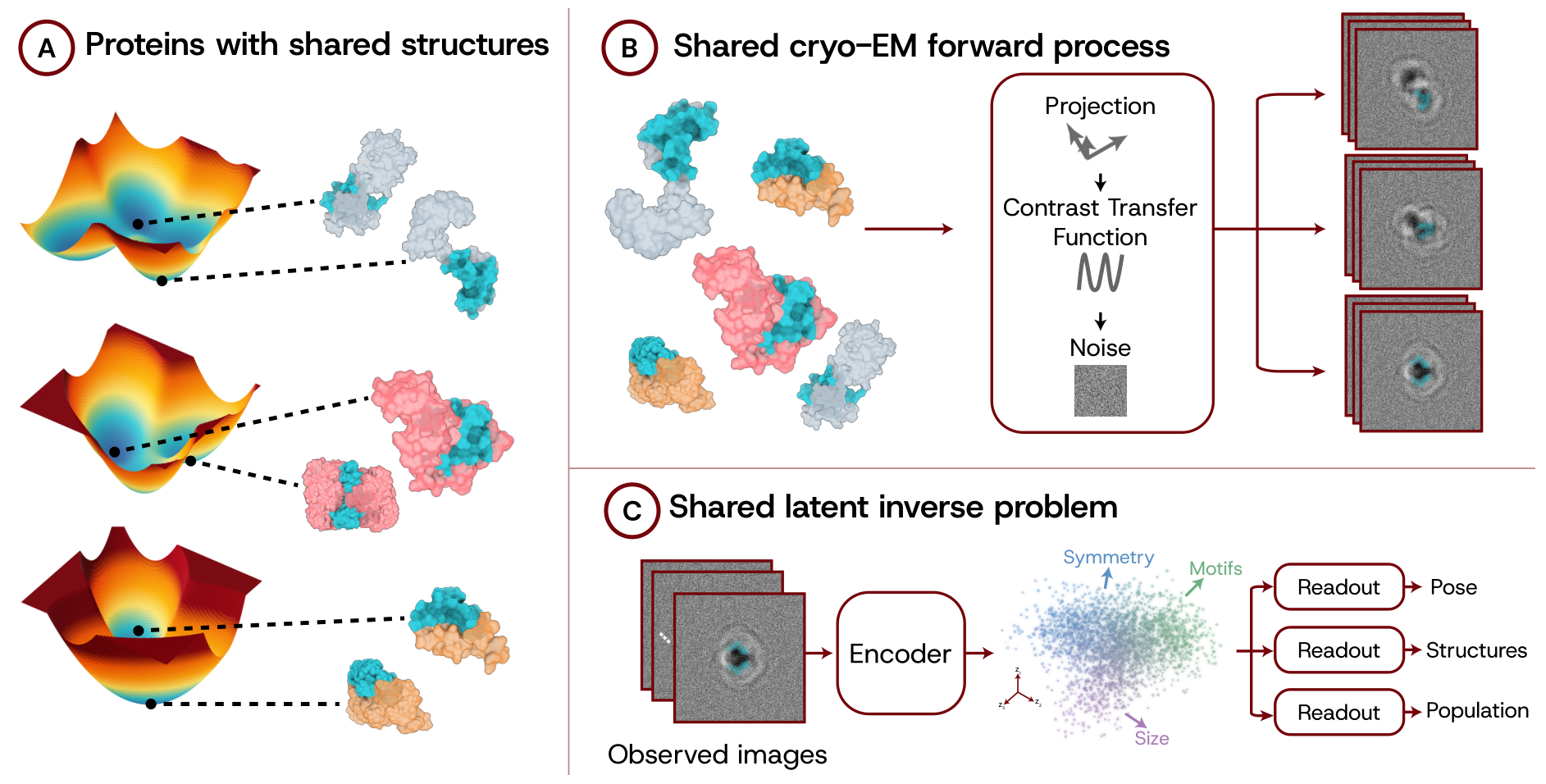
EMber overview showing shared protein structures, cryo-EM image formation, and a shared encoder for pose, structure, and population inference.

EMber: Learning the Shared Latent Structure of Cryo-EM Inverse Problems

Nithin Chalapathi, Theo Sternlieb, Ethan Han, Sonya M. Hanson, Pilar Cossio, Aditi S. Krishnapriyan, Ritwik Gupta

arXiv preprint, 2026

Paper Code arXiv DOI BibTeX
Abstract summary

EMber learns reusable representations of cryo-EM particle images for several inverse problems, including analysis of molecular variability and reconstruction. Its vision transformers use self-distillation with global and local objectives, combining more than 50 million experimental particle images from 214 EMPIAR datasets with simulated views of 268,000 molecular assemblies. Controlled evaluations test whether the features capture molecular structure rather than acquisition conditions. The learned representations improve discrimination between molecular states and compositions, support population estimation with a linear probe, and accelerate reconstruction through useful particle assignments.
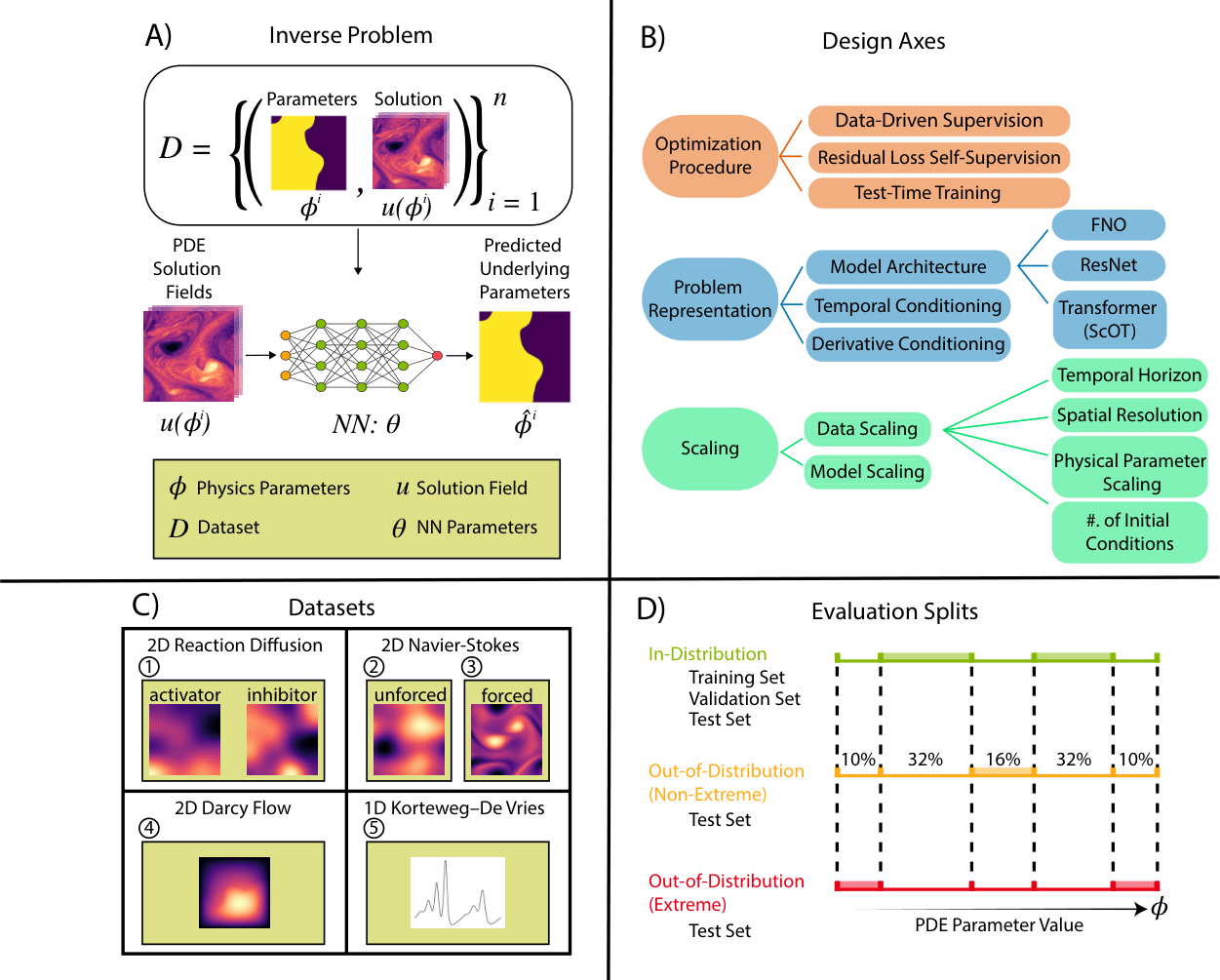
PDEInvBench overview showing inverse parameter estimation, neural-network design axes, PDE datasets, and evaluation splits.

PDEInvBench: A Comprehensive Dataset and Design Space Exploration of Neural Networks for PDE Inverse Problems

Divyam Goel, Nithin Chalapathi, Sanjeev Raja, Aditi S. Krishnapriyan

Transactions on Machine Learning Research (TMLR), 2026

Paper Code Dataset TMLR DOI BibTeX
Abstract summary

PDEInvBench benchmarks how neural networks recover physical parameters from observed PDE solutions. It covers time-dependent and steady-state equations, with evaluation across familiar and unfamiliar parameter regimes. The study compares training objectives, network representations, and model and dataset scaling. Results favor supervised initialization followed by physics-based test-time refinement, show benefits from providing PDE derivatives as input, and highlight the value of diverse initial conditions. The released dataset and evaluation code support reproducible comparisons of methods for PDE inverse problems.

Neural Spectral Methods: Self-supervised learning in the spectral domain

Neural Spectral Methods: Self-supervised learning in the spectral domain

Yiheng Du, Nithin Chalapathi, Aditi S. Krishnapriyan

International Conference on Learning Representations (ICLR), 2024

Paper Code Publication BibTeX
Abstract

We present Neural Spectral Methods, a technique to solve parametric Partial Differential Equations (PDEs), grounded in classical spectral methods. Our method uses orthogonal bases to learn PDE solutions as mappings between spectral coefficients. In contrast to current machine learning approaches which enforce PDE constraints by minimizing the numerical quadrature of the residuals in the spatiotemporal domain, we leverage Parseval’s identity and introduce a new training strategy through a spectral loss. Our spectral loss enables more efficient differentiation through the neural network, and substantially reduces training complexity. At inference time, the computational cost of our method remains constant, regardless of the spatiotemporal resolution of the domain. Our experimental results demonstrate that our method significantly outperforms previous machine learning approaches in terms of speed and accuracy by one to two orders of magnitude on multiple different problems. When compared to numerical solvers of the same accuracy, our method demonstrates a 10x increase in performance speed.

Inferring Visualization Intent from Conversation

Inferring Visualization Intent from Conversation

Haotian Li*, Nithin Chalapathi*, Huamin Qu, Alvin Cheung, Aditya G. Parameswaran

ACM International Conference on Information and Knowledge Management (CIKM), 2024

Paper DOI BibTeX
Abstract

During visual data analysis, users often explore visualizations one at a time, with each visualization leading to new directions of exploration. We consider a conversational approach to visualization, where users specify their needs at each step in natural language, with a visualization being returned in turn. Prior work has shown that visualization generation can be boiled down to the identification of visualization intent and visual encodings. Recognizing that the latter is a well-studied problem with standard solutions, we focus on the former, i.e., identifying visualization intent during conversation. We develop Luna, a framework that comprises a novel combination of language models adapted from BERT and rule-based inference, that together predict various aspects of visualization intent. We compare Luna with other conversational NL-to-visualization and NL-to-SQL approaches (adapted to visualization intent), including GPT-3.5 and GPT-4, and demonstrate that Luna has 14.3% higher accuracy than the state-of-the-art. We also apply Luna to a usage scenario on a dataset of police misconduct, showcasing its benefits relative to other approaches.

Scaling physics-informed hard constraints with mixture-of-experts

Scaling physics-informed hard constraints with mixture-of-experts

Nithin Chalapathi, Yiheng Du, Aditi S. Krishnapriyan

International Conference on Learning Representations (ICLR), 2024

Paper Code Publication BibTeX
Abstract

Imposing known physical constraints, such as conservation laws, during neural network training introduces an inductive bias that can improve accuracy, convergence, and data efficiency for modeling physical dynamics. While such constraints can be softly imposed via loss function penalties, recent advancements in differentiable physics and optimization improve accuracy by incorporating PDE-constrained optimization as individual layers in neural networks. This enables a stricter adherence to physical constraints, and provides greater control to scale between soft and hard constraints. However, imposing hard constraints significantly increases computational and memory costs, especially for complex dynamical systems. This is because it requires solving an optimization problem over a large number of points in a mesh, representing spatial and temporal discretizations, which greatly increases the complexity of the constraint. To address this challenge, we develop a scalable approach to enforce hard physical constraints using Mixture-of-Experts (MoE). Our approach imposes the constraint over smaller decomposed domains, each of which is solved by an “expert” through differentiable optimization. During training, each expert independently performs a localized backpropagation step by leveraging the implicit function theorem; the independence of each expert allows for parallelization across multiple GPUs. Compared to standard differentiable optimization, our scalable approach achieves greater accuracy for predicting the dynamics of challenging non-linear systems. We also improve training stability and require significantly less computation time during both training and inference stages.

TopoAct: Visually Exploring the Shape of Activations in Deep Learning

TopoAct: Visually Exploring the Shape of Activations in Deep Learning

Archit Rathore*, Nithin Chalapathi*, Sourabh Palande, Bei Wang

Computer Graphics Forum (CGF), 2021

Paper Project Publication DOI BibTeX
Abstract

Abstract Deep neural networks such as GoogLeNet, ResNet, and BERT have achieved impressive performance in tasks such as image and text classification. To understand how such performance is achieved, we probe a trained deep neural network by studying neuron activations, i.e.combinations of neuron firings, at various layers of the network in response to a particular input. With a large number of inputs, we aim to obtain a global view of what neurons detect by studying their activations. In particular, we develop visualizations that show the shape of the activation space, the organizational principle behind neuron activations, and the relationships of these activations within a layer. Applying tools from topological data analysis, we present TopoAct, a visual exploration system to study topological summaries of activation vectors. We present exploration scenarios using TopoAct that provide valuable insights into learned representations of neural networks. We expect TopoAct to give a topological perspective that enriches the current toolbox of neural network analysis, and to provide a basis for network architecture diagnosis and data anomaly detection.

Adaptive Covers for Mapper Graphs Using Information Criteria

Adaptive Covers for Mapper Graphs Using Information Criteria

Nithin Chalapathi, Youjia Zhou, Bei Wang

IEEE International Conference on Big Data (Big Data), 2021

Paper DOI BibTeX
Abstract

The mapper construction is a widely used tool from topological data analysis in obtaining topological summaries of large, high-dimensional point cloud data. It has enjoyed great success in data science, including cancer research, sports analytics, and visualization. However, developing practical and automatic parameter selection for the mapper construction remains a challenging open problem for both the topological analysis and visualization communities. In this paper, we focus on parameter selection for the 1-dimensional skeleton of the mapper construction, called the mapper graph. Specifically, we explore how information criteria used in the X-means clustering algorithm can inform and generate adaptive covers for mapper graphs. Our approach thus makes novel progress towards automatic parameter selection for the mapper construction using information theory.

Correctness-preserving Compression of Datasets and Neural Network Models

Correctness-preserving Compression of Datasets and Neural Network Models

Vinu Joseph, Nithin Chalapathi, Aditya Bhaskara, Ganesh Gopalakrishnan, Pavel Panchekha, Mu Zhang

IEEE/ACM International Workshop on Software Correctness for HPC Applications (Correctness), 2020

Paper DOI BibTeX
Abstract

Neural networks deployed on edge devices must be efficient both in terms of their model size and the amount of data movement they cause when classifying inputs. These efficiencies are typically achieved through model compression: pruning a fully trained network model by zeroing out the weights. Given the overall challenge of neural network correctness, we argue that focusing on correctness preservation may allow the community to make measurable progress. We present a state-of-the-art model compression framework called Condensa around which we have launched correctness preservation studies. After presenting Condensa, we describe our initial efforts at understanding the effect of model compression in semantic terms, going beyond the top n% accuracy that Condensa is currently based on. We also take up the relatively unexplored direction of data compression that may help reduce data movement. We report preliminary results of learning from decompressed data to understand the effects of compression artifacts. Learning without decompressing input data also holds promise in terms of boosting efficiency, and we also report preliminary results in this regard. Our experiments centered around a state-of-the-art model compression framework called Condensa and two data compression algorithms, namely JPEG and ZFP, demonstrate the potential for employing model-and dataset compression without adversely affecting correctness.

Show all publications Show selected publications
Mapper Interactive: A Scalable, Extendable, and Interactive Toolbox for the Visual Exploration of High-Dimensional Data

Mapper Interactive: A Scalable, Extendable, and Interactive Toolbox for the Visual Exploration of High-Dimensional Data

Youjia Zhou, Nithin Chalapathi, Archit Rathore, Yaodong Zhao, Bei Wang

IEEE Pacific Visualization Symposium (PacificVis), 2021

Paper Code Project DOI BibTeX
Abstract

The mapper algorithm is a popular tool from topological data analysis for extracting topological summaries of high-dimensional datasets. In this paper, we present Mapper Interactive, a web-based framework for the interactive analysis and visualization of high-dimensional point cloud data. It implements the mapper algorithm in an interactive, scalable, and easily extendable way, thus supporting practical data analysis. In particular, its command-line API can compute mapper graphs for 1 million points of 256 dimensions in about 3 minutes (4 times faster than the vanilla implementation). Its visual interface allows on-the-fly computation and manipulation of the mapper graph based on user-specified parameters and supports the addition of new analysis modules with a few lines of code. Mapper Interactive makes the mapper algorithm accessible to nonspecialists and accelerates topological analytics workflows.

Interactive Visualization of Interdependent Power and Water Infrastructure Operation

Interactive Visualization of Interdependent Power and Water Infrastructure Operation

Han Han, Konstantinos Oikonomou, Nithin Chalapathi, Masood Parvania, Bei Wang

IEEE Power & Energy Society Innovative Smart Grid Technologies Conference (ISGT), 2020

Paper DOI BibTeX
Abstract

With increasing levels of drought across the world together with the rising demand of freshwater and energy consumption, the interdependence between power and water sectors is becoming increasingly important. However, as power and water system operators have traditionally operated their systems in isolation, there is a lack of understanding of the interdependence and interactions between these systems. This paper bridges this information gap by developing 2D and 3D visualization prototypes for interdependent power and water distribution systems. These prototypes aim to display and monitor a variety of water and energy variables, and to increase the observability and controllability for power and water distribution system operations. Visualization results show that the proposed prototypes successfully monitor the energy requirements for meeting the energy and water demands and capture operational decisions that can improve energy efficiency and reduce operating costs of interdependent systems.

Technical writing

Introducing Vision-Language Reinforcement Learning in SkyRL

Nithin Chalapathi, Sumanth Hegde, Philipp Moritz, Kourosh Hakhamaneshi

Bringing vision-language models into SkyRL’s post-training workflows, from supervised fine-tuning to agentic reinforcement learning. Covers multimodal input consistency, multi-turn training recipes, and visual environments.